
Hearing damage after an accident? We make sure the claim counts all of it.
Serious injuries change work, family and daily life. We make sure the claim counts all of it, now and later. Free case review, no fee unless we win, and a real person answers 24/7.











Get your free case evaluation
Three fields. We call or text you back within the hour.
Do these four things now
The first few days decide a lot of cases. In order:
What you can get paid for
A serious injury claim covers everything the injury took from you, now and later.
Find out what your case is worthResults
Deadlines vary. Act early.
How long you have depends on the type of case and who is responsible. Some claims, such as those against a government agency, have deadlines measured in months, not years. Call early, and we find the deadline that applies to you.
Serious injury questions we get every day
Straight answers. No fine print.
How much is my injury case worth?
What if I was partly at fault?
How much do you charge?
Serious injury cases in nine states
Staffed offices in Irvine, Chicago and Las Vegas, and satellite offices by appointment. We also come to you.
More about hearing damage
Read the full guide
When we think of hearing loss, we may think of a person who has listened to loud music or worked in noisy industrial buildings or construction areas for years, or of the natural decline of the auditory senses with age. But hearing damage is one of the most common injuries in any accident involving a powerful blow to the side of the head, or a sudden jolt, such as whiplash.
Serious traumatic injuries to the ear can cause permanent hearing loss, balance problems, or a constant ringing or buzzing in the ears, known as tinnitus, and may result from:
- Motor vehicle accidents
- Slip and fall accidents
- Assault
- Abuse
- Workplace injury
Airbags and Hearing Loss
Serious and permanent hearing injuries can result from airbag deployment in a traffic accident. Airbags use a tiny explosive to inflate at a high speed to protect the person from fatal injury. The sound of this explosion may be greater than 170 decibels, which is louder than jet engine at takeoff (140 decibels), or a shotgun blast (165 decibels), and slightly quieter than a rocket launch (180 decibels).
The tremendous sound explosion of the airbag, which can cause severe ear pain, loud ringing, and bleeding from the ear canals, can damage any of the structures in the ear, causing immediate and permanent hearing loss ("acoustic trauma"). The occupants in a car in which the airbag deployed may suffer from ruptured eardrums, significant loss of equilibrium (or vertigo, causing unsteadiness or dizziness), or permanent and persistent ringing of the ears (tinnitus). The damage to a victim's ears may also result from the sudden violent contact of the airbag with the person's head.
Research shows that 17 percent of people whose airbags deployed in a traffic accident suffer some degree of permanent hearing loss.
Anatomy of Hearing Loss
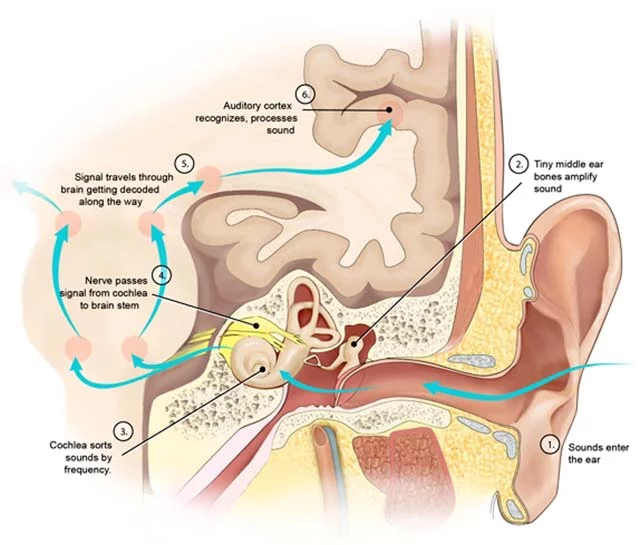
The ear is made up of three parts: the outer ear, the middle ear, and the inner ear.
The outer ear captures the sound vibration and sends it through the ear canal to the middle ear.
The middle ear contains the eardrum and the ossicles, or three tiny bones—the hammer, anvil, and stirrup. Sound causes the eardrum to vibrate; the ossicles amplify these vibrations and carry them to the inner ear.
The inner ear is a snail-shaped labyrinth of interconnected, tube-like chambers filled with fluid and lined with four rows of tiny hair cells, or cilia. The labyrinth houses the cochlea, the organ for hearing, as well as the organs for balance. When sound vibrations are strong enough, the cilia translate them into electrical nerve impulses in the auditory nerve. This nerve sends electrical signals to the brain, which interprets them as sound.
The labyrinth is surrounded by the temporal bone. If you suffer a blow to the head that causes a temporal bone fracture, it can lead to several types of ear injuries:
- A temporal bone fracture, which can lead to hearing loss, permanent injury to the inner ear, and any of the below injuries.
- A labyrinthine concussion, or inner-ear concussion, which causes dizziness, vertigo, or tinnitus.
- The dislocation or fracture of the middle ear bones, which leads to conductive hearing loss.
- A hole in the inner ear leading to inner ear fluid leakage.
- Bleeding in the inner ear.
To diagnose a fracture of the temporal bone, X-rays or even a CT scan may be necessary.
Types of Hearing Damage
There are two main types of hearing loss: conductive hearing loss and sensorineural hearing loss. The part of the ear that sustains an injury determines the type of hearing loss the victim suffers.
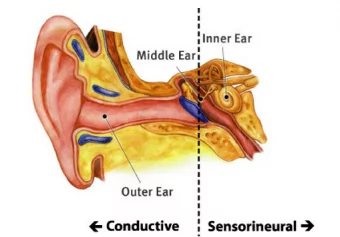
Conductive hearing loss is due to some mechanical problem in the external or middle ear that blocks the sound waves before they reach the inner ear. The ossicles may fail to conduct sound to the cochlea, the eardrum may fail to vibrate in response to sound, or there may be fluid in the middle ear. One of the most common causes of conductive hearing loss is an accumulation of ear wax, which an otolaryngologist can safely and quickly extract.
In sensorineural hearing loss, sound reaches the inner ear, but a dysfunction in the cochlea or the auditory nerves prevent the signal from going to the brain. The most common reason for hearing loss is due to injury to the cilia that transmit sound through the ear.
Examples of sensorineural hearing loss include noise-induced hearing loss and age-related hearing loss. Sensorineural hearing loss often makes it difficult to hear high tones, such as women's or children's speech. It may be difficult to hear the person you are talking to if there is background noise. Sensorineural hearing loss is not reversible.
Another, less frequent form of hearing loss is central hearing loss, in which the ear works, but the brain has difficulty understanding sounds because the parts of the brain that control hearing are damaged. This type of hearing loss may occur after a traumatic brain injury.
Symptoms of Ear Injury or Hearing Damage
Symptoms of hearing loss include muffled hearing, difficulty understanding what people are saying especially when there is background noise. Other symptoms that may accompany hearing loss include ringing, roaring, hissing, or buzzing in the ear (tinnitus), ear pain, itching or irritation, pus or fluid leaking from the ear, and vertigo.
If someone you know has sustained an ear injury and has started listening to the television or radio at a higher volume than before, is avoiding conversation and social interaction, or seems depressed, it may be due to hearing loss. Encourage your loved one to see a doctor. A person who suffers hearing loss may be subject to loneliness, despair, social isolation, depression, and loss of independence. In many cases, hearing aids and other treatments can help.
If you have suffered a sudden loss of hearing as the result of head trauma, see your doctor as soon as possible. Your doctor may refer you to an ear, nose, and throat specialist ("otolaryngologist") or an audiologist.
If your sudden hearing loss is combined with any of the following symptoms, it is an indication of traumatic brain injury, and you should call 911 or seek immediate medical care:
- Facial droop
- Numbness or paralysis on one side of the face or body
- Eye or vision problems, such as blurred or double vision, or the inability to see out of one eye
- Slurred speech, the inability to speak, or difficulty understanding speech
- Difficulty standing or walking (ataxia)
- Falling of stumbling a lot (clumsiness)
- Severe nausea or vomiting
- Dizziness or lightheadedness
- Vertigo (a sudden feeling of spinning or whirling that feels like moving while sitting or standing still)
- Sudden ringing or buzzing in the ears (tinnitus)
- Blood or other fluid (other than earwax) oozing out the ear
- Headaches
- Major fatigue
Recovery
Depending on the place and extent of injury to the ear, it may heal on its own or may require surgery. Some surgeries can repair damaged eardrums. Ossicles (the three small bones of the middle ear) can be replaced with artificial bones.
If there is no cure for the hearing loss, a hearing aid for one or both ears usually helps, whether the hearing loss is the result of either conductive or sensorineural problems. When a hearing aid does not provide enough amplification, as with profound deafness, a cochlear implant may help. A cochlear implant transmits signals directly into the auditory nerve via surgically implanted electrodes in the cochlea.
What Can I Do?
If you or a loved one has suffered an injury that has interfered with your hearing, contact a lawyer with experience handling ear injury and hearing damage cases. In the case of an accident injury, it is important to contact such a law firm promptly, as the law firm may want to send its own investigators to the scene of the accident to inspect and take pictures of the accident site and any dangerous condition that caused or contributed to the accident, especially before there is a change in the condition of the area or vehicle. The attorney or his or her investigator will also want to talk to any witnesses to the accident as soon as possible while the facts are still fresh in their minds.
An experienced personal injury law firm can also help you obtain appropriate and thorough medical care for your physical, emotional, and psychological injuries suffered as a result. The attorneys in the firm will also help you obtain full compensation for your medical expenses, pain and suffering, mental anguish, property damage, lost wages, and all your other injuries and damages.
The attorneys at TorkLaw have successfully handled many personal injury cases involving hearing loss or tinnitus. We understand the physical, financial, and emotional toll the loss of hearing takes on the injured victim and his or her family. We have worked with some of the top audiologists, doctors and hearing experts in California to recover the maximum damages on behalf of our clients, and we can do the same for you. Call now and talk to one of our lawyers for a free no obligation consultation of your case. Call now: 888.845.9696.
Not sure if you have a case? Call anyway. It's free to ask.
Someone answers 24/7. English and Spanish. No obligation.

New clients 888.845.9696Existing clients 888.222.8286
This is a paid advertisement for TORKLAW, not an offer or guarantee of results. Every case is different and must be evaluated on its own merits. Some matters may be referred to partner firms as appropriate. Contacting us does not create an attorney-client relationship. Tracy R. Horn, Esq. is responsible for this advertisement. Main Office: 18650 MacArthur Blvd, Suite 300, Irvine, CA 92612.